
NIH grants quick start
A step-by-step guide to writing NIH research, training, and small-business grant applications, with AI-powered templates for every mechanism.

15+ NIH activity codes
R01, R21, R03, R15, SBIR/STTR, and more, each with its own template, page limits, and scoring guidance.
Institute-specific guidance
Pick NCI, NHLBI, NIMH, or any institute and get section prompts aligned with its priorities.
Compass AI research assistant
Literature search, eligibility analysis, and section-level feedback inside your workspace.
NIH grant mechanisms we support
Each mechanism has different page limits, review criteria, and template requirements. GrantCopilot handles the differences automatically.
R01: Research Project Grant
The gold standard for established research. 3–5 year awards with a 12-page Research Strategy and preliminary data expected.
12 pages · Preliminary data
R21: Exploratory Grant
Early-stage, high-risk / high-reward research. Up to 2 years with a 6-page strategy and no preliminary data required.
6 pages · No prelim data
R03 / R15: Small Grants
Pilot studies and feasibility testing with limited scope. Ideal for new investigators at primarily undergraduate institutions.
6 pages · $50K/year
U01 / U13: Cooperative Agreements
Multi-site research with substantial NIH programmatic involvement. Collaborative design and shared governance.
12 pages · Collaborative
R25: Education Grant
Training and education programs, curriculum development, and research experiences for students and early-career scientists.
Training focus · Education
SBIR / STTR: Small Business
Commercializable technology with a business entity. Phase I for feasibility, Phase II for full development.
Business required · Commercialization
R01: the flagship NIH research grant
The R01 is NIH's most common and most competitive research grant mechanism, supporting independent research projects across every institute. GrantCopilot includes a dedicated R01 template with Specific Aims structure validation, Research Strategy guidance, and Simulated Peer Review scoring so you can submit a stronger application.
Award length
3–5 years, renewable
Who can apply
Independent investigators at any career stage
Preliminary data
Expected, strengthens your Approach section
Review criteria
Significance, Investigator(s), Innovation, Approach, Environment
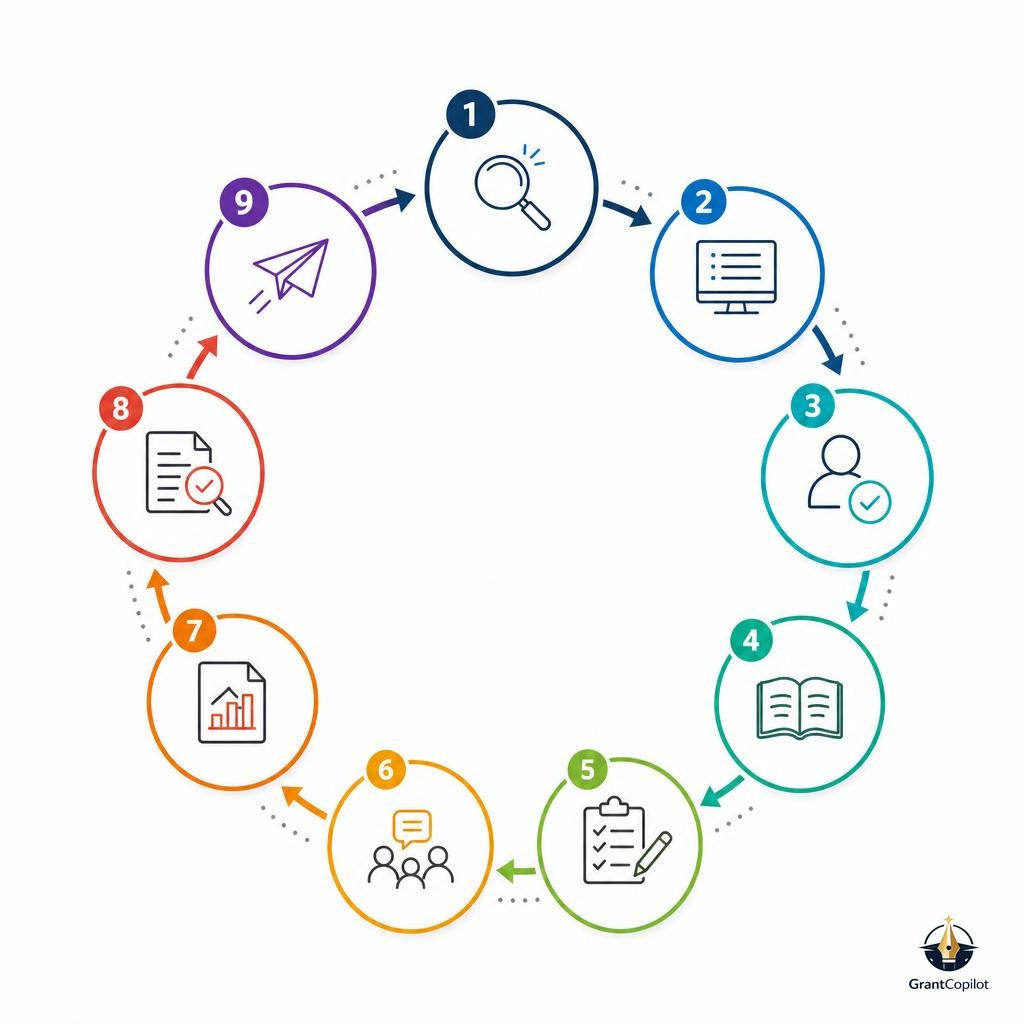
Nine steps from search to submission
Follow this workflow for any NIH mechanism. GrantCopilot adapts every step to your selected activity code and institute.
01
Choose your grant mechanism
Select R01, R21, R03, SBIR, or one of 15+ NIH activity codes. GrantCopilot generates the correct template structure, page limits, and review criteria automatically.
02
Find NIH funding opportunities
Search by keyword, FOA number, institute (NCI, NHLBI, NIMH), or mechanism type. Always download and read the full Funding Opportunity Announcement before applying.
03
Create your proposal
Start from a bookmarked grant or create a blank proposal. Select your mechanism and NIH institute, and the system auto-populates grant details and sets up institute-specific sections.
04
Write Specific Aims (1 page)
The most important page of your application. Include your opening hook, long-term goal, central hypothesis, rationale, 2–3 testable aims, and expected outcomes, all under 800 words.
05
Write Research Strategy (6–12 pages)
Three scored subsections: Significance (why it matters), Innovation (what's new), and Approach (methods, rigor, reproducibility, timeline, and alternative approaches for each aim).
06
Use Compass AI throughout
Click the Compass icon in any section for eligibility checks, deep literature research, competitive intelligence, section analysis, and institute-specific writing guidance.
07
Complete supporting documents
Project Summary (30 lines), Project Narrative (3 sentences), Bibliography, Facilities & Resources, Biosketches (NIH format), Budget & Justification, and Data Management & Sharing Plan.
08
Run Simulated Peer Review
Before you export, use the ‘Simulated Peer Review’ feature inside your proposal. An AI CSR reviewer scores your full proposal on the official 1–9 scale using the review framework NIH assigns to your mechanism and flags priority revisions. Use it to catch weaknesses before a real study section does.
09
Export & submit
Export to PDF, run an internal review, verify NIH formatting (fonts, margins, page limits), assemble in ASSIST, and submit at least 2–3 days before the deadline.
Research Strategy: the three scored sections
NIH reviewers score Significance, Innovation, and Approach separately. GrantCopilot provides AI feedback aligned with the 1–9 scoring scale.
A. Significance
What problem or barrier are you addressing? Why does it matter to health and science? How will your work advance the field? What is the potential impact?
B. Innovation
What is new or improved in your approach? Are you challenging existing paradigms? Are you using novel methods or technologies? How does this advance beyond current work?
C. Approach
Rationale and experimental design for each aim. Methods, protocols, data collection, rigor and reproducibility, expected outcomes, potential problems, and alternative approaches.
Tips for stronger NIH proposals
Practical guidance from successful applicants, covering everything from Specific Aims structure to budget thresholds and study-section strategy.
Specific Aims
The most important page of every NIH application
- Write your Specific Aims page last, after your full Research Strategy is drafted.
- Keep it to exactly 1 page (~800 words). Reviewers decide here whether to champion your application.
- Structure: opening hook → knowledge gap → long-term goal → central hypothesis → 2–3 testable aims → expected outcomes & impact.
- Each aim should be independent: if one fails, the others should still be achievable.
Rigor & reproducibility
A top reviewer concern across all mechanisms
- Address scientific rigor explicitly: blinding, randomization, sample-size justification, and statistical approach.
- Include authentication plans for key biological and chemical resources.
- Discuss how sex as a biological variable (SABV) is factored into your experimental design.
- Describe how results will be reproducible by sharing protocols, data, and reagents when possible.
Page limits & formatting
Applications that exceed limits are returned without review
- R01: 12 pages · R21: 6 pages · R03: 6 pages · SBIR Phase I: 6 pages · SBIR Phase II: 12 pages.
- Use Arial 11 pt or Georgia 11 pt fonts with at least 0.5-inch margins on all sides.
- Use GrantCopilot's word-count tracker in each section to stay on target.
- Figures and tables count toward page limits, so plan their placement carefully.
Review & scoring
Understand how study sections evaluate your application
- For most research project grants (R01, R03, R15, R21, R33, R61, U01), reviewers score three factors on the 1–9 scale under the Simplified Peer Review Framework: Importance of the Research, Rigor and Feasibility, and Expertise and Resources. Fellowships use their own three criteria; some mechanisms still use the classic five.
- Your Overall Impact score is holistic, not a simple average of individual scores.
- Address all review criteria explicitly: reviewers use a checklist and will note omissions.
- Consider requesting assignment to a specific study section that aligns with your research area.
Budget strategy
Budget mistakes can sink an otherwise strong application
- Use modular budgets for requests ≤ $250K/year direct costs, and detailed budgets for anything above.
- Justify every line item: connect personnel effort, equipment, and travel directly to your aims.
- Check your institution's negotiated indirect-cost rate and apply it correctly.
- If your budget is close to a threshold (e.g., $500K direct), consult your program officer before submitting.
Submission & follow-up
What to do before and after you hit submit
- Submit through ASSIST, Workspace, or grants.gov. Institutional sign-off is required first.
- For due dates on or after January 25, 2026, biosketches and Current & Pending (Other) Support must use the Common Forms completed and certified in SciENcv, with an ORCID iD linked to your eRA Commons profile.
- Deadlines are typically 5:00 PM local time, so submit at least 2–3 days early for portal issues.
- Save your eRA Commons confirmation and a complete copy of the assembled application.
- Review takes 6–9 months. If not discussed, ask your program officer for summary statements.
- NIH limits each PD/PI to six new, renewal, resubmission, or revision applications per calendar year (T and R13 excluded), per NOT-OD-25-132.
- Per NOT-OD-25-132, NIH will not consider applications substantially developed by AI to be your original ideas. Use AI-generated drafts as a starting point and substantially revise them in your own words, grounded in your own ideas and verified citations.
Ready to write your NIH proposal?
Start a free trial to access NIH-specific templates, Compass AI research, and section-by-section scoring guidance.
Frequently asked questions
GrantCopilot supports 15+ NIH activity codes including R01, R21, R03, R15, R25, R33, R41–R44, R61, U01, U13, S10, G07, DP1, and SBIR/STTR (Phase I & II). Each mechanism generates a customized template with the correct sections, page limits, and review criteria.
No. You can create a proposal directly from the 'Write Proposal' page and enter grant details manually. However, starting from a bookmarked grant auto-populates the title, agency, opportunity number, and description for you.
Compass provides NIH-specific features: institute-tailored section prompts, literature search for Significance and Innovation, competitive-intelligence analysis, Specific Aims structure validation, and Research Strategy feedback aligned with NIH scoring criteria (1–9 scale).